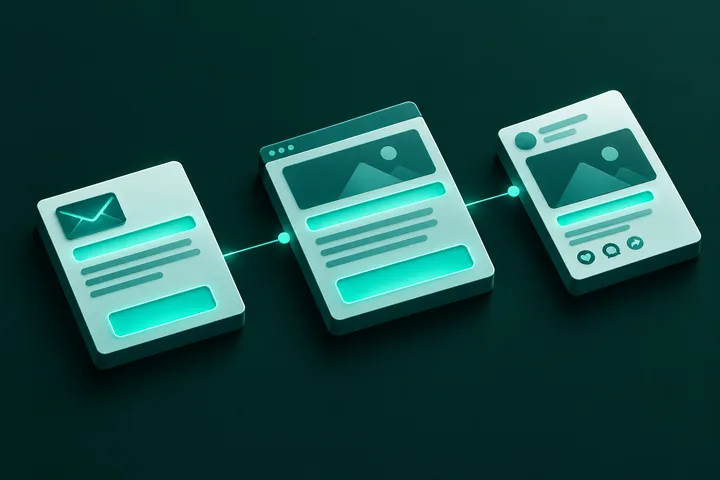
The AIDA model is a framework that maps the four stages a customer moves through before acting: Attention, Interest, Desire and Action. You use it by giving each stage its own job in your ad, email or landing page: grab attention, hold interest with useful information, build desire with proof and benefits, then make the next step easy to take.
Key takeaways
- Use strong hooks to grab attention.
- Keep your audience engaged with valuable and relevant content.
- Create emotional desire by showing real-life benefits.
- Make it easy to act with clear calls to action and incentives.
- AIDA works because it mirrors how people make decisions: they rarely buy the moment they first hear of something.
Marketing is about capturing people's attention, sparking their interest and convincing them to act. But how do you structure your marketing messages effectively? That is where the AIDA model comes in: a proven framework that guides customers from awareness to purchase.
If you are new to marketing, understanding AIDA will help you create more engaging content, ads and campaigns that drive real results. This post breaks down the AIDA model, explains how it works and shows how to use it in your marketing strategy.
What is the AIDA model?
The AIDA model outlines the four key stages a customer goes through before making a purchase decision:
Attention (sometimes called awareness): grabbing the customer's attention.
Interest: piquing curiosity and keeping them engaged.
Desire: creating an emotional connection and building demand.
Action: encouraging them to take the next step (buy, subscribe, sign up and so on).
The model is usually credited to the American advertising pioneer E. St. Elmo Lewis, who described these stages in the late 1890s. It is still widely taught because the stages are simple enough to apply to almost any message. The sections below look at each stage and how to apply it.
Stage 1, attention: how do you get noticed?
Before you can sell anything, you need to make sure people notice you. This is the first impression stage, where the goal is to break through the noise and grab attention.
How to create attention-grabbing marketing
- Use bold headlines and eye-catching visuals.
- Use curiosity-driven hooks (for example, "You won't believe this trick…").
- Focus on pain points or aspirations your audience cares about.
- Use social media, SEO and ads to reach a larger audience.
Example: a skincare brand could start with a striking Instagram ad:
"Struggling with dry skin? Discover the secret to 24-hour hydration!"
Stage 2, interest: how do you keep your audience engaged?
Now that you have their attention, it is time to keep them interested. This is where you provide valuable information that keeps them reading, watching or listening.
How to build interest in your product or service
- Share intriguing facts, benefits or unique features.
- Tell engaging stories that resonate with your audience.
- Use videos, infographics or blog posts to explain your solution.
- Highlight how your product or service solves a common problem.
Example: a fitness coach might create a blog post:
"The Top 3 Exercises to Burn Belly Fat (Without Spending Hours at the Gym!)."
Stage 3, desire: how do you make your audience want it?
At this stage you have sparked interest; now you need to turn it into desire. You want your audience to feel emotionally connected to your product or service and to see how it fits into their life.
How to create desire for your product
- Show success stories and testimonials from happy customers.
- Highlight unique benefits (for example, "100% organic" or "money-back guarantee").
- Use emotional storytelling to build a personal connection.
- Offer social proof (for example, "Trusted by 50,000+ customers worldwide").
Example: a travel agency could showcase a customer testimonial:
"Thanks to this agency, I had the best vacation of my life in Bali! Stress-free planning and unforgettable experiences."
Stage 4, action: how do you encourage the next step?
Once your audience is interested and emotionally invested, it is time to ask them to act. Whether it is making a purchase, signing up for a newsletter or downloading an e-book, the goal is to remove friction and make it easy to convert.
How to encourage action
- Use clear and compelling calls to action (CTAs) (for example, "Buy Now" or "Sign Up Today").
- Offer limited-time deals or incentives (for example, "Get 20% off – Today Only!").
- Reduce hesitation with guarantees (for example, "Try it risk-free for 30 days").
- Make the checkout or sign-up process simple and seamless.
Example: an online course provider might use a CTA like:
"Join Today & Get Your First Lesson Free!"
What does the AIDA model look like in a real campaign?
Here is AIDA applied to a simple email marketing campaign for an online productivity tool. The lines are example copy, not real results:
Attention: "Tired of feeling overwhelmed? This simple app will change the way you work!"
Interest: "Our users save an average of 10 hours per week with our smart task management system."
Desire: "See how Jane, a busy entrepreneur, doubled her efficiency with just one tweak."
Action: "Start your free trial today—no credit card required!"
Each line does one job. Notice that the email does not ask for the trial until the reader has a reason to want it; asking for action before building interest and desire is the most common way a message skips a stage.
Why does the AIDA model work?
The AIDA model works because it mirrors how humans make decisions. People rarely buy something immediately; they go through a process of awareness, interest, desire and action. By structuring your marketing messages with AIDA, you can guide your audience smoothly from "Who are you?" to "I need this now!"
Real buyer journeys are not always this tidy. People can skip stages, loop back or see several messages across channels before they act. AIDA is most useful as a checklist for a single message or a sequence: does each piece earn attention, hold interest, build desire and make the action clear?
Now that you know how to use AIDA, try applying it to your next ad, social media post or email campaign and watch how your results change. If you want the desire stage to rest on a real audience tension rather than a guess, our creative brief template walks through persona, tension, angle and story.
What's next? Need help crafting an AIDA-driven campaign? Get in touch with us and we will brainstorm together how you can apply it to your business.
Related reading
- Persona, tension, angle, story: an AI copywriting framework that works
- What is a consumer tension in marketing, and how do you find one?
- What is creative clickability, and can you predict it before spend?
- Which social media advertising metrics matter, and how do you optimise them?
- Creative brief template: persona, tension, angle, story
FAQ
What does AIDA stand for?
Attention, Interest, Desire and Action. The first stage is sometimes called awareness, but the job is the same: getting noticed.
Where can I use the AIDA model?
In almost any marketing message: ads, social media posts, emails, landing pages and blog posts. Each piece should grab attention, hold interest, build desire and make the action easy.
Why does the AIDA model work?
It mirrors how people make decisions. They rarely buy straight away, and instead move from awareness through interest and desire to action.
What is the most common AIDA mistake?
Asking for action too early. A call to action works best once the message has earned attention, held interest and built desire with benefits and proof.