Brand case study · Ride-hailing · Philippines
inDrive's rivals buy app installs on Google, leaving brand display empty
For inDrive, SOMIN analysed 24 months of commuter-focused Google ads from 7 Philippine ride-hailing and delivery brands. inDrive had 169 brand detections, behind Maxim and Angkas; rivals ran almost only app-install campaigns.
The challenge
Why the brief moved from Grab to inDrive and commuters
Grab, the original subject, ran no Google Ads of its own in 24 months; its measured paid media was 100% Facebook. inDrive has a real Google footprint.
The approach
8 quarterly studies of commuter-filtered Google paid media
- Used only Google Search, Search Partners, Display Network and YouTube ads.
- Tracked tensions, personas and formats each quarter.
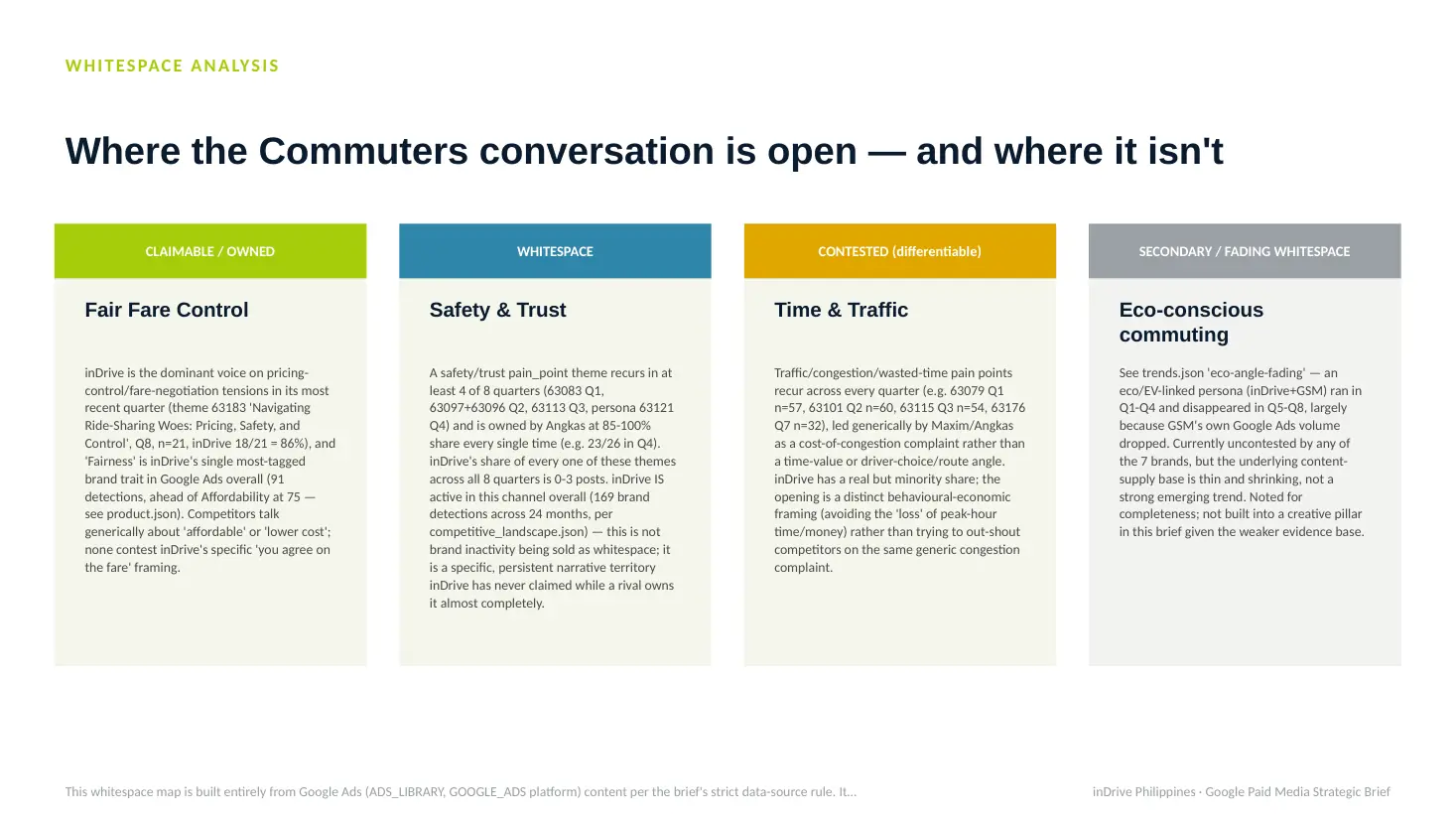
- Sorted narratives into owned, whitespace, contested and fading lanes.
- Built persona-to-proposition insight chains.
- Took colours and tone from inDrive's organic posts.
Key findings
App-install sameness, ownable fairness and Angkas-held safety
One format for everyone
All 194 sampled creatives in Year 1 and 179 of 185 in Year 2 were app-install campaigns; none was bespoke, brand-led display.
Fairness is ownable
It is inDrive's top brand trait, 91 detections to Affordability's 75. Rivals pitch lower cost generically; none contest agree-on-the-fare.
Safety belongs to Angkas, for now
Safety and trust recurs in at least 4 of 8 quarters, Angkas at 85-100% share each time and inDrive at 0-3 posts.
What SOMIN delivered
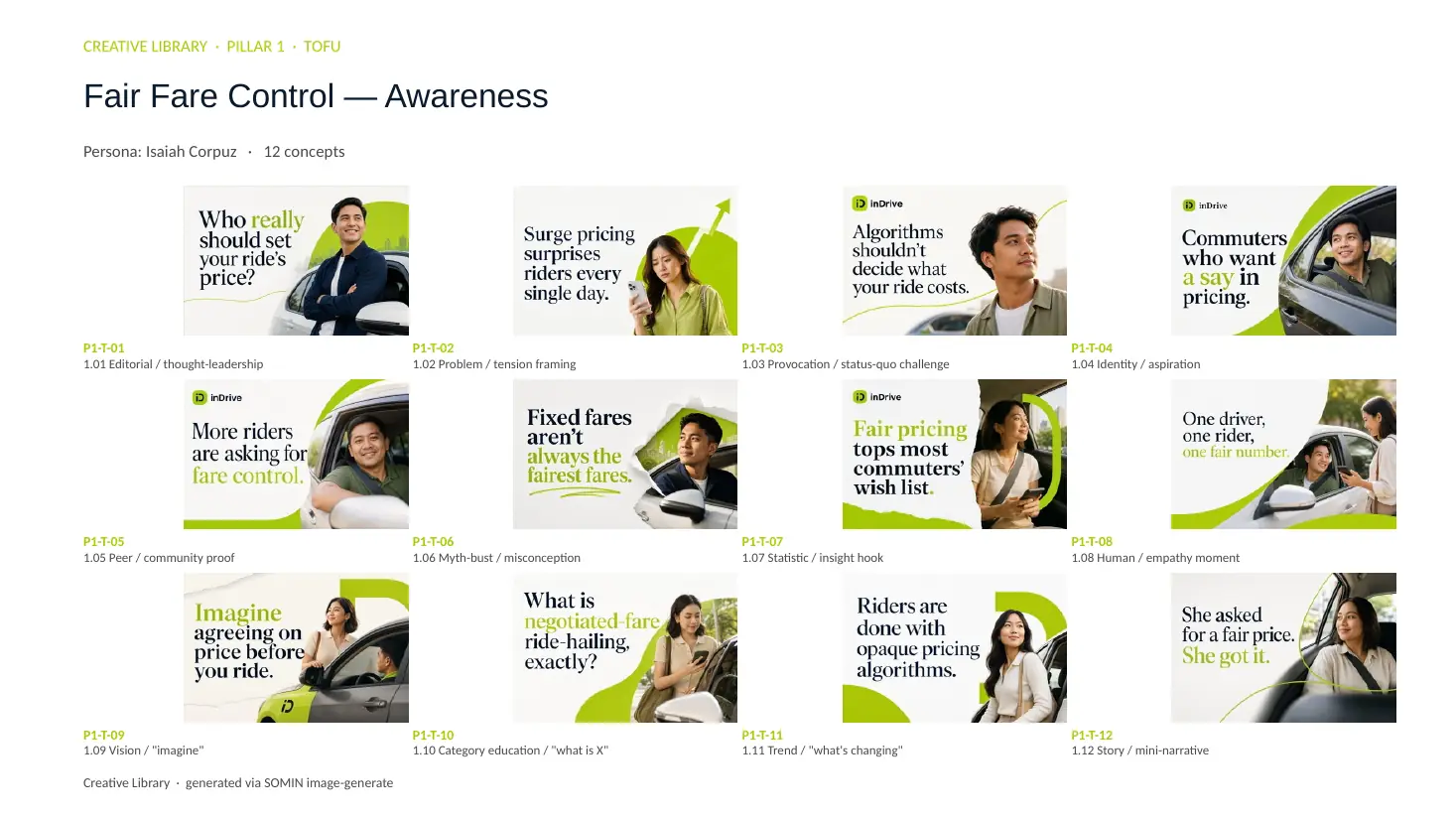
A whitespace map, 3 insight chains and 108 inDrive banners
- 7-brand share of voice
- Quarterly trends labelled stable, falling or directional
- Lanes: Fair Fare Control, Safety & Trust, Time & Traffic and fading eco-conscious commuting
- 3 insight chains with propositions
- 108 banners, headlines and CTAs 9 words or fewer
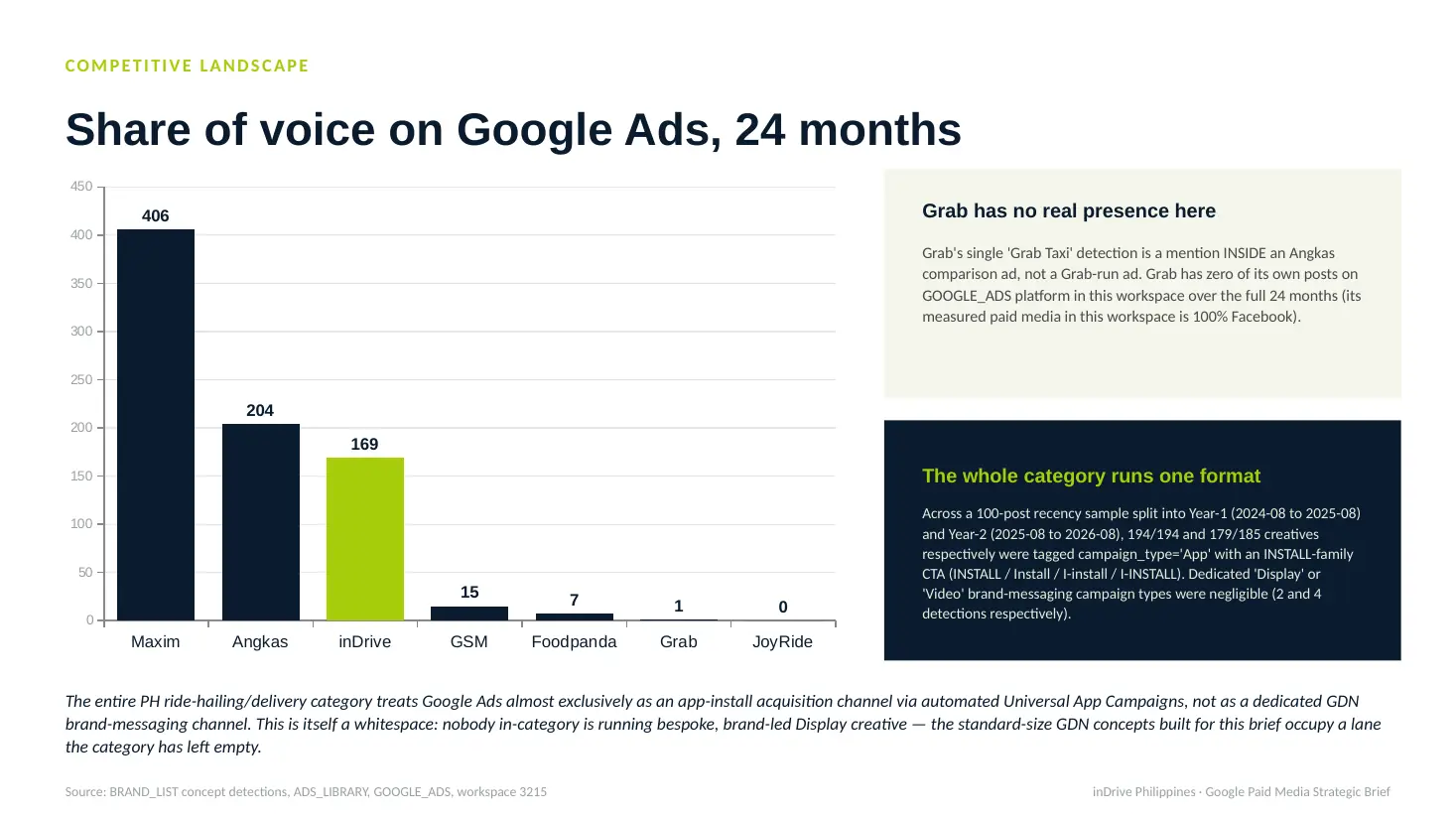
“This is itself a whitespace: nobody in-category is running bespoke, brand-led Display creative”
From the SOMIN brief
The outcome
inDrive should own fare-setting and claim Safety & Trust
Lean display into “you set the fare together”, a claim only inDrive makes, and take the Safety & Trust whitespace. Frame time and traffic as loss aversion, not a louder congestion complaint.
FAQ
inDrive case study FAQ
About SOMIN
SOMIN is a Singapore-based AI marketing-intelligence platform. It turns real-time competitor and audience data into pre-scored propositions, briefs and creative concepts for brands, agencies and creator programmes across 11+ markets.
Built by seasoned marketers and an AI professor: the methods behind this study are peer-reviewed at AAAI, ACM Multimedia, SIGIR, WSDM and in ACM TOIS. See the research and talks.
Why does the case mention Grab?
It was the original subject but had no Google Ads of its own, so the brief moved to inDrive.
What does the creative library include?
SOMIN image-generate banners in inDrive's brand identity: 36 per pillar, 12 each for awareness, consideration and conversion.
Can the figures be checked?
Yes. Every figure traces to a SOMIN platform ID in the brief's audit trail.
Get the full inDrive case study
Every page of the brand briefing: the data, the whitespace, the personas and the creative. Free, straight after a short form.