A consumer tension is the conflict between what a person wants and what stops them getting it, described the way they would describe it, for example: "I want to act fast, but I'm afraid of choosing wrong." You find one by reading what a defined audience actually posts and responds to, grouping the frictions that recur, and checking that each has two real forces pulling against each other before anyone writes a line of copy.
Key takeaways
- A tension has two sides, a want and a barrier; a pain point usually has only one.
- The angle explains why the tension exists, ideally with a named behavioural theory, and the insight turns that explanation into one line.
- The chain runs persona, tension, angle, story, and every link should point back to evidence you can show.
- Three tensions from SOMIN's insight library show the method: the cost of inaction, drowning in advertising data and the AI project nobody will stop.
- A tension is ready to brief when you can quote it, count it, explain it and own it.
What is a consumer tension?
A tension is a stand-off inside the customer. Two things they want, or a want and a fear, cannot both be satisfied, so they stall, compromise or look for someone to resolve it. "I want my family to eat well, but I don't have time to cook" is a tension. "Cooking takes too long" is only half of one.
Tensions matter because they explain behaviour that features and prices do not. A product that eases the stand-off earns attention, and copy that names it earns recognition. Copy that ignores it sounds like every other brand in the category.
The quickest test is a sentence: "I want ___, but ___." If you cannot fill both blanks with something a real person in the audience would say, you do not have a tension yet.
How is a tension different from a pain point and an insight?
A pain point is one side of a tension, and an insight explains it. Strategyzer, which created the Value Proposition Canvas, defines customer pains as anything that annoys customers before, during and after getting a job done. That is a list of irritations. A tension adds the opposing pull that makes the irritation hard to fix, and the angle and insight explain why the two collide.
| Term | What it is | Example, from the cost-of-inaction tension below |
|---|---|---|
| Pain point | A single frustration or obstacle | Reliable data is hard to get and to interpret |
| Tension | Two forces in conflict, in the customer's terms | I need to keep up with shifting trends, but I'm afraid of making the wrong call |
| Angle | The mechanism behind the tension, named | Loss Aversion: a possible loss weighs more than an equal gain |
| Insight | The truth that reframes it, in one line | "Inaction can be the greatest loss of all." |
| Story | The narrative or creative a brand builds on it | A brief, a script or a campaign line |
The pain point tells you where it hurts. The tension tells you why the customer has not already fixed it, which is where a brand can help.
How does a tension turn into a story?
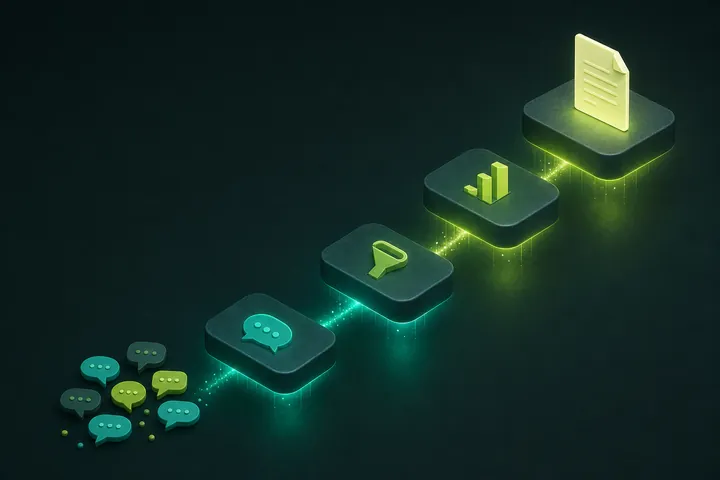
The tension sits second in a four-step chain. SOMIN's insight engine and the persona, tension, angle, story framework we use for AI copywriting both work in this order:
- Persona: who feels the tension, drawn from the people and content in the category rather than a demographic guess.
- Tension: the conflict, grouped from the many posts or ads that express it.
- Angle: why it happens, named with a behavioural, psychological, sociological or economic theory.
- Story: a one-line insight and a short narrative that a brief or a script can use.
The angle is the step that turns a complaint into an argument. The same tension can carry several angles, and each leads to different copy.
What do real consumer tensions look like?
These three come from SOMIN's insight library. Each persona, tension and angle was generated by SOMIN's models from published posts and ads, so read them as grounded hypotheses rather than survey results. The insight lines are quoted exactly as stored.
The cost of inaction (Loss Aversion)
- Persona: the Strategic Innovator, a planner focused on business strategy, market research and consumer behaviour, with a strong need for knowledge and security. SOMIN built it from 53 ads in its audience-research workspace, most of them from GWI and Euromonitor.
- Tension: "Navigating the Unpredictable: The Cost of Inaction in Business Strategy", a cluster of 64 of the 166 audience-research ads SOMIN studied for 7 January to 7 April 2026. Businesses struggle to keep up with shifting consumer trends, find reliable data hard to access and interpret, and fall behind when they fail to act.
- Angle: Loss Aversion, from Prospect Theory. Amos Tversky and Daniel Kahneman showed in 1979 that people judge outcomes as gains and losses from a reference point, and that the value curve is steeper for losses than for gains. A team that fears a wrong decision more than it values a right one waits.
- Insight: "Inaction can be the greatest loss of all."
The copy implication: reframe doing nothing as the risky choice, and make the first step small enough that it does not feel like a bet.
Drowning in advertising data (Cognitive Load Theory)
- Persona: the Ambitious Marketing Innovator, an advertising and marketing professional who wants to understand audiences better and seeks empowerment through knowledge. SOMIN built it from 16 organic posts, mostly Nielsen's.
- Tension: "Navigating Inefficiencies in Modern Advertising Strategies", 65 of the 191 posts aimed at advertising agencies that four audience-research firms published between July 2024 and April 2026, with 2,061 engagements between them. The cluster covers wasted spend from poor targeting, outdated demographic assumptions and a lack of reliable ROI data.
- Angle: Cognitive Overload, from Cognitive Load Theory. In John Sweller's 1988 paper in Cognitive Science, demanding problem-solving consumes so much of a person's limited processing capacity that little is left for learning. The angle applies that to media planning: a marketer facing data from every channel at once decides worse, not better.
- Insight: "Simplicity slays complexity—the quieter the message, the louder its impact."
The same persona and tension also produced a second angle, herd behaviour, after Abhijit Banerjee's 1992 model of people copying the crowd instead of using their own information. Its insight reads "To truly connect, dare to diverge from the trending path." One tension, two angles: the first sells clarity, the second sells independence.
The AI project nobody will stop (Escalation of Commitment)
- Persona: the Strategic Innovator in SOMIN's ads-optimisation workspace, a digital marketer and technology strategist interested in AI and marketing automation.
- Tension: "Navigating the AI Marketing Paradox: Challenges and Opportunities", 105 of 250 posts in a 24-month study of SOMIN's own channels, which shows the method works on your own content too. Teams know AI matters but struggle to implement it, pursue AI initiatives without a strategic foundation and waste the investment.
- Angle: Escalation of Commitment, first studied by Barry Staw in 1976: people keep investing in a failing course of action they chose themselves. Later replications of Staw's original experiment have produced mixed results, so treat it as a tendency to check for, not a law.
- Insight: "Commitment should not blind your vision."
Copy built on this angle gives the reader permission to stop: a review point, an exit criterion, a way to admit a tool is not working without losing face.
How do you find a consumer tension, step by step?
- Fix the scope. One audience, one category, one date range. The cost-of-inaction tension came from a single quarter of ads in one category.
- Collect what people publish. Posts, comments, ads, reviews and search queries from the audience and the brands around it. A few hundred items is enough to start: 166 ads produced the first example above.
- Log every friction in the audience's words. Copy phrases, not summaries. "I don't know which tool to trust" is more useful than "decision complexity".
- Group and count. Cluster similar frictions and record how many items and how much engagement sit behind each cluster. A tension resting on four posts is a lead, not a finding.
- Find the opposing pull. For each cluster, write "I want ___, but ___." Drop clusters that only have one side.
- Test two or three angles. Ask why the tension exists and try candidate theories from behavioural economics, psychology or sociology. Check each definition against the original source, not a summary.
- Write the insight and check it. Can you point to the posts behind it? Would the persona recognise it? Could a competitor run it unchanged? If yes to the last, sharpen it.
- Put it in a brief. Persona, tension, angle, story and the evidence, on one page. Our creative brief template follows the same order.
SOMIN's Strategy agent automates most of steps two to seven on live category data and keeps the link from each insight to the posts behind it. Whatever tool you use, keep that link; it is what lets someone else check your work, a point we cover in why marketers distrust AI insights.
How do you know a tension is strong enough to brief?
Run four checks before it goes to a creative team.
- Quote it. You can show real posts or comments that say it, in the audience's language.
- Count it. You know how many items carry it, over what period, and from which sources.
- Explain it. You can name the mechanism and cite where the theory comes from.
- Own it. Your brand has a credible role in easing it, and the category leader is not already saying the same thing.
A tension that passes all four gives a brief something specific to argue. One that fails the first two is an opinion; one that fails the last is someone else's campaign. For turning a passing tension into a full brief, see how to turn a social listening insight into a campaign brief.
FAQ
What is a consumer tension in simple terms?
It is a conflict between what a customer wants and what holds them back, such as wanting to eat well but having no time to cook. Naming it explains why the customer has not already solved the problem.
What is the difference between a pain point and a tension?
A pain point is a single frustration. A tension pairs that frustration with an opposing want or fear, which is why it persists. Briefs built on tensions give copy something to resolve, not just something to complain about.
Is a consumer tension the same as a consumer insight?
No. The tension is the conflict; the insight is the one-line truth that explains or reframes it. One tension can produce several insights, depending on the angle you take.
How many posts do you need to find a tension?
A few hundred items from one audience and category is usually enough to see clusters form. What matters more is that each tension rests on many items, not a handful, and that you can show them.
Can AI find consumer tensions?
AI can cluster thousands of posts and propose tensions and angles quickly, which is how SOMIN's insight engine works. Treat the output as a hypothesis: open the evidence, check the theory and confirm the persona before it goes into a brief.
Sources
- Strategyzer: How do I add customer pains to my Value Proposition Canvas?
- Tversky and Kahneman (1979), Prospect Theory: An Analysis of Decision under Risk, Econometrica 47(2)
- Sweller (1988), Cognitive Load During Problem Solving: Effects on Learning, Cognitive Science 12(2)
- Banerjee (1992), A Simple Model of Herd Behavior, Quarterly Journal of Economics 107(3)
- Staw (1976), Knee-deep in the big muddy: a study of escalating commitment to a chosen course of action, Organizational Behavior and Human Performance 16(1)