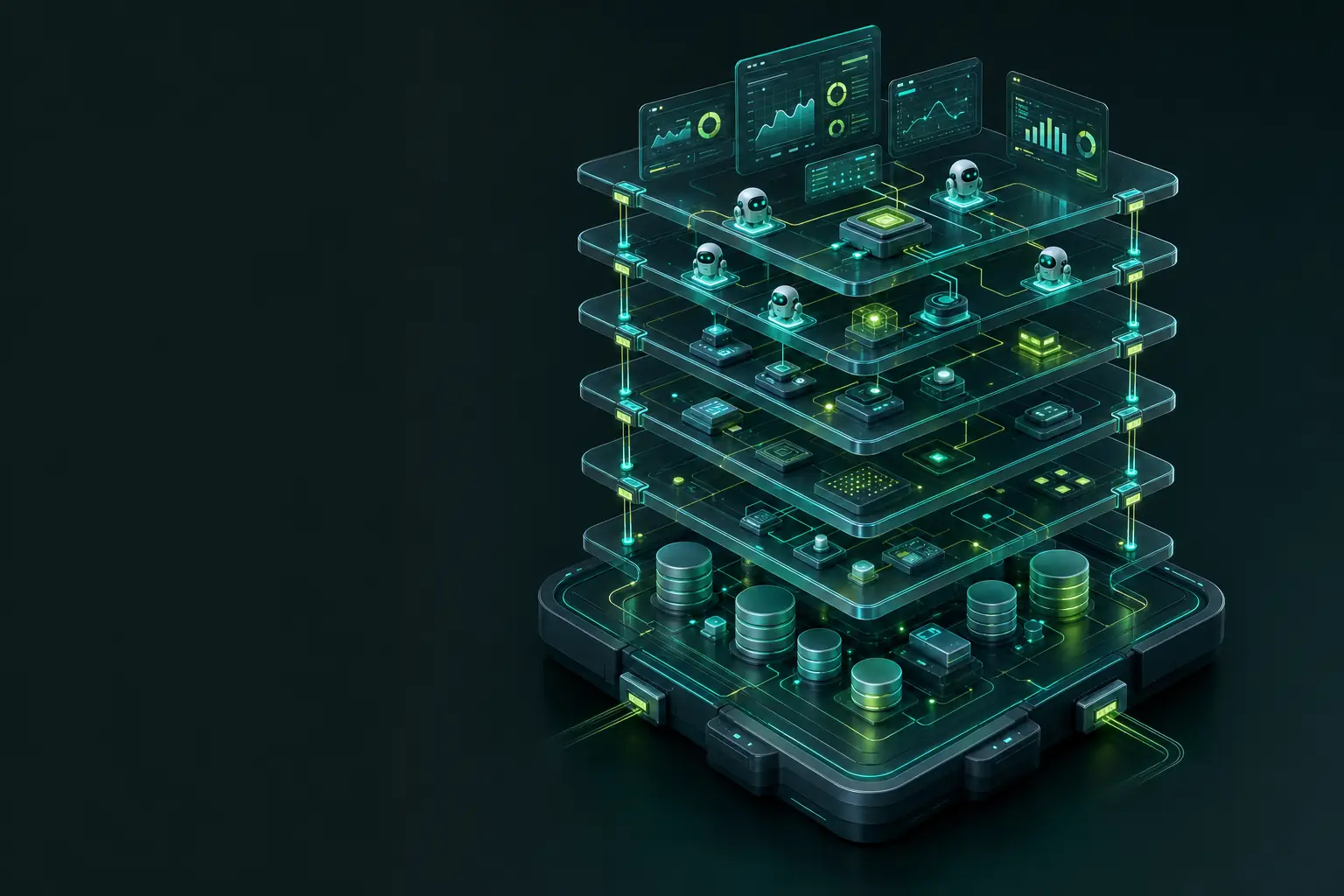
A 2026 marketing operations stack has six layers: data, intelligence, decision, production, distribution and measurement. What changed this year is who moves work between them. Dashboards showed people what happened and left the next step to them. Agents now read the same data, propose the next action and carry it out through standard connectors such as MCP, with people approving at set gates.
Key takeaways
- Treat the stack as six layers with one job each, not as a list of tools.
- Agents do not fix a weak layer; they expose it, which is why data readiness comes first.
- MCP gives agents one standard way to reach your systems, so integration becomes a connector rather than a project.
- Keep a human gate on anything that spends, sends or publishes, and make autonomy a setting per agent.
What are the layers of a marketing operations stack?
Six layers, each answering one question: what do we know, what does it mean, what should we do, what do we make, where does it go, and did it work? The table shows how each layer changes as agents arrive.
| Layer | Its job | Dashboard era | Agent era | Human gate |
|---|---|---|---|---|
| Data | Collect and unify first-party, platform, social and competitor data | Exports, warehouses and nightly syncs | Agents query sources live through connectors | Access rights and personal-data rules |
| Intelligence | Understand audiences, competitors and whitespace | Quarterly research decks and listening reports | A category read refreshed continuously, with evidence attached | An analyst checks the evidence trail |
| Decision | Choose the angle, audience, budget and timing | Planning meetings and spreadsheets | Agents propose ranked options with predicted outcomes | A strategist approves the plan |
| Production | Make copy, images, video and emails | Briefs, studios and AI writing tools | On-brand variants generated and pre-scored | Brand and claims QA |
| Distribution | Publish, traffic and send | Schedulers, ad managers and email platforms | Agents build campaigns and sequences, held for approval | Sign-off on spend and sends |
| Measurement | Report, attribute and learn | Dashboards and weekly reports | Results written back and compared with predictions | The owner reviews what the loop learned |
Why are dashboards no longer enough?
Dashboards answer "what happened" and stop. Someone still has to read them, decide what they mean and switch to another tool to act, and that hand-off is where much of marketing's time goes.
SOMIN's ads-optimisation workspace shows how this feels from the inside. Its moments-of-truth model surfaces the thoughts "How can I make sense of all this data?" and "I need to simplify this data to make better decisions" for a persona juggling metrics across platforms. The workspace's insight "In a world drowning in data, simplicity is the anchor for clarity" draws on Cognitive Load Theory: too much data leads to decision fatigue (27 engagements across 74 posts).
SOMIN's audience-research workspace points at the cause. Its insight "Tools alone can't compose a masterpiece; harmony is born from their unison" applies Systems Theory to fragmented marketing tools. It sits on the tension theme "Addressing the Challenges of Marketing Efficiency and Insight", which a January 2026 social-listening study of 1,817 posts sized at 254. More dashboards on fragmented tools add views, not answers.
What changes when AI agents join the stack?
The layers stay; the hand-offs between them become automatic. An agent can read the intelligence layer, draft the decision, produce the assets and stage them for distribution, so people spend their time approving and correcting instead of copying data between tools.
That also exposes weak layers quickly. In Gartner's October 2025 survey of 413 martech leaders, 81% were piloting or running AI agents. Yet 45% of those with agents said vendor-offered agents were not meeting expectations of business performance, and half said their organisation lacked the technical and data stack readiness to deploy them.
SOMIN's social-listening data finds the same pattern in public conversation. An October 2026 study of 129 posts includes a theme on AI-driven marketing (sample 36) whose summary is blunt: audience data fragmentation leads to ineffective strategies despite faster AI tools. An agent acting on fragmented data automates the fragmentation, so fix the data and intelligence layers first.
What agents do well today
- Reading a category continuously and summarising what changed.
- Generating many variants of an idea and pre-scoring them.
- Building campaigns, sequences and calendars in the tools you already use.
- Comparing what was predicted with what happened, every cycle.
Where does MCP fit in the stack?
MCP is the wiring between layers. The Model Context Protocol, which Anthropic introduced as a universal, open standard for connecting AI applications to external systems, lets one agent reach your data, tools and platforms through a common interface instead of a custom integration per tool.
It is no longer one vendor's project. In December 2025, Anthropic donated MCP to the Agentic AI Foundation, a fund under the Linux Foundation co-founded with Block and OpenAI. It reported more than 10,000 active public MCP servers, and adoption in ChatGPT, Gemini, Microsoft Copilot, Cursor and Visual Studio Code.
For marketing ops, that changes three things. Integration becomes a connector you switch on rather than a project you scope. The AI assistant your team already uses becomes a work surface for the whole stack. And access is easier to govern, because each connector exposes a defined set of tools, so you decide which an agent may read from and which it may write to.
SOMIN's free Marketing Mondays plugin works this way, connecting Claude to SOMIN's category data through an MCP server.
Where should humans stay in the loop?
At every step that spends money, sends a message or publishes to the public. Work before those points can run on its own; those points should wait for a person.
That is how SOMIN's AI agents are designed. The Paid Media agent pushes top-scoring ads into a campaign built paused until someone approves the spend. The CRM and email agent needs two human approvals, one for the approach and one for the built sequences, and has a kill switch that pauses the whole loop in under 60 seconds. The Social Media Manager runs autonomously only if the team chooses that setting.
Make autonomy a setting per agent, not a company-wide policy. An agent that writes a weekly summary needs less oversight than one that changes bids.
How do you modernise your stack without starting again?
- Map your tools to the six layers. Gaps and duplicates show up quickly, such as several production tools and nothing that keeps the category read current.
- Fix the data layer. Agree definitions, owners and access rules before any agent touches it.
- Add an intelligence layer with evidence. Every insight should link to the posts, ads or records behind it.
- Connect read-only first. Give agents read access through MCP connectors and let them draft, not act.
- Automate one hand-off with a gate. Pick the most repetitive step, such as brief to first draft, and add an approval.
- Measure prediction against outcome. If the loop is not getting more accurate each cycle, it is not learning.
- Retire dashboards nobody opens. Replace them with a summary the agent writes and a person reads.
FAQ
What is a marketing operations stack?
The data, tools and processes a marketing team uses to plan, make, publish and measure its work. In 2026 it is best described as six layers: data, intelligence, decision, production, distribution and measurement.
What is MCP in marketing?
The Model Context Protocol is an open standard that lets AI assistants and agents connect to external systems, such as analytics, a CRM or a marketing-intelligence platform, through one common interface.
Will AI agents replace marketing operations teams?
They replace hand-offs, not judgement. Ops teams move from shuttling data between tools to owning data quality, designing the approval gates and deciding what agents may do on their own.
Do we still need marketing dashboards?
Yes, for monitoring, but fewer of them. Keep the ones people act on and let agents write plain-language summaries for the rest.
This quarter, draw your stack as six layers and mark who moves work between each one. Wherever the answer is "someone copies it across", you have a candidate for an agent; wherever the data underneath is disputed, you have work to do first. Start with one connected, gated hand-off, measure it, and expand from there.