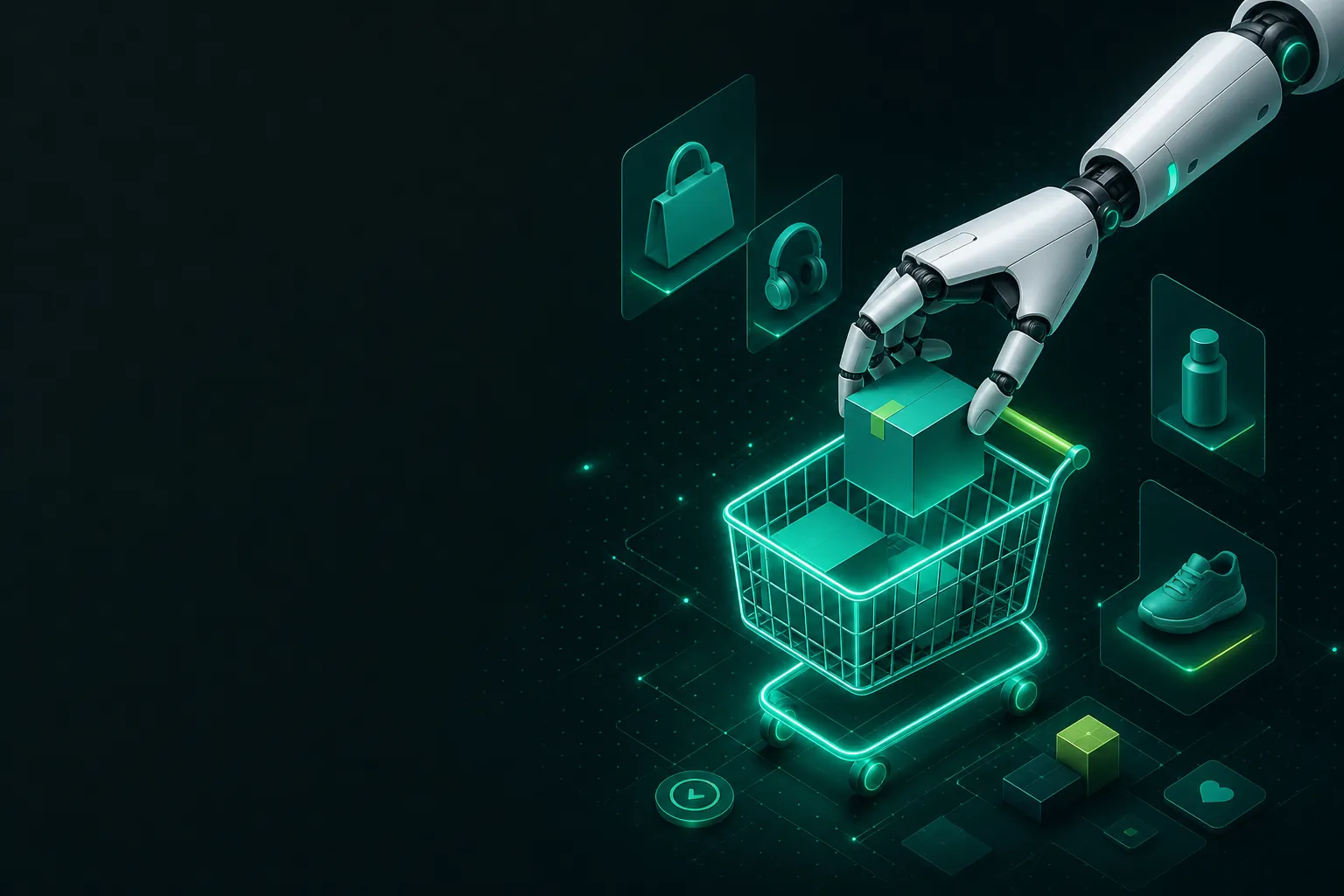
Agentic commerce is buying done by AI agents on a person's behalf: the agent searches, checks stock, negotiates and completes the purchase without the person ever seeing an ad or a landing page. Brands get chosen by making their product data machine-readable, keeping their APIs fast enough for agent-to-agent negotiation and tracking Share of Model, a measure of how often AI systems recommend them over competitors. The click stops being the measure of success; being selected replaces it.
Key takeaways
- In agentic commerce the buyer you need to convince is often a machine making a decision, not a person browsing a site.
- An agent can parse thousands of SKUs, verify stock, negotiate a loyalty discount through a merchant's API and finish the purchase; if your data is not machine-readable, your brand does not exist to that buyer.
- Southeast Asia is skipping basic e-commerce for agentic AI, much as it skipped desktops for mobile.
- Share of Model, how often AI reasoning engines recommend or select your brand, is replacing Share of Voice as the metric that matters.
- Winning it takes semantically structured product data, low API latency and many algorithmic creative variations, run through AgentOps.
Why is the click losing its value?
For years, marketing was a battle for the human eye. We obsessed over UI/UX, agonised over "omnichannel" touchpoints, and treated the "click" as the ultimate validation of success.
But as we settle into 2026, the landscape has fractured. We are no longer just selling to people; we are selling to the AI Agents that represent them. Welcome to the era of Agentic Commerce, where the primary consumer isn't a person browsing a site, but a machine making a decision.
How does an AI agent buy on someone's behalf?
Traditional e-commerce was designed for the "fickle human," someone who compares, hesitates, and gets distracted by a shiny banner ad. Agentic commerce is built for the "decisive machine."
Consider a typical 2026 transaction: A user tells their AI, "Get me a waterproof jacket for Hanoi by Thursday, under $100." In the time it takes you to blink, that agent has:
Parsed thousands of SKUs across the web.
Verified real-time stock levels.
Negotiated a loyalty discount via a merchant’s API.
Finalised the purchase.
The human never saw a landing page. They never saw an ad. If your brand’s data isn't "machine readable," your brand simply doesn't exist to that buyer.
Why is Southeast Asia moving first?
While Western markets often struggle with legacy digital infrastructure, Southeast Asia is "leapfrogging" the old guard. Much like the region skipped desktops for mobile, ASEAN is now skipping basic e-commerce for Agentic AI.
The numbers tell the story:
Vietnam: Leads the charge with a staggering 93% AI adoption rate among businesses.
Malaysia & Thailand: Rapidly integrating AI into SME logistics and cross-border trade.
By utilising AI-driven translation and automated supply chains, local players are no longer just "local" they are competing at a global scale without the need for massive marketing departments.
What is Share of Model, and how do you win it?
The CMO’s dashboard is undergoing a radical redesign. "Share of Voice" is a vanity metric in a world where agents do the listening. The new KPI is Share of Model (SoM).
SoM measures how frequently AI "reasoning engines" recommend or select your brand over a competitor. To win the SoM game, leaders must pivot on three fronts:
Semantic Structuring: Your product data can’t just be a pretty photo. It must be organised in a high-dimensional "vector space" that AI agents can parse for context and quality.
Latency is Loss: In agent-to-agent negotiation, speed is the ultimate currency. If your API takes two seconds to respond while a competitor’s takes 200ms, you’ve already lost the sale.
Algorithmic Creativity: Instead of one "hero" campaign, brands now use AI to generate thousands of micro-variations. These aren't for humans to see they are designed to appeal to the specific parameters identified by the buyer’s agent.
What is AgentOps, and how does SOMIN support it?
The transition is already yielding results. Early adopters in the region have seen lead costs drop by 40% while lead quality has doubled. The "human" element hasn't vanished; it has shifted. We are moving toward an Agent-to-Agent (A2A) economy.
To survive, leadership must look beyond basic chatbots and invest in AgentOps, the operational framework required to manage a fleet of AI agents that represent, defend, and sell your brand 24/7. SOMIN offers brands an intelligence layer to compete for Share of Model in an agent-driven economy. By structuring media signals, market behaviour, and performance data through SODA and SOMONITOR, it provides content types, themes, personas, and campaign intents, along with organic and paid insights into how brands are interpreted by AI systems.
This leads to quicker decision-making and optimised campaigns for machine selection. As Agentic Commerce grows in Southeast Asia, SOMIN helps brands transition from marketing execution to AgentOps, ensuring they are consistently chosen in AI-mediated transactions.
The window for experimentation is closing. In 2026, you don't just want to be seen. You want to be selected.
FAQ
What is agentic commerce?
It is commerce in which AI agents act for people: a user states what they want and the agent searches, compares, negotiates and buys. The primary consumer becomes a machine making a decision rather than a person browsing a site.
What is Share of Model (SoM)?
Share of Model measures how often AI reasoning engines recommend or select your brand over a competitor. The article argues it replaces Share of Voice as the key metric once agents do the listening.
How do I make my brand machine-readable?
Product data has to be more than a good photo. It needs to be structured so AI agents can parse it for context and quality, which the article describes as organising it in a high-dimensional vector space.
Why does API speed matter in agentic commerce?
In agent-to-agent negotiation, speed is the currency. If your API takes two seconds to respond while a competitor's takes 200 milliseconds, the sale may already be lost.
What is AgentOps?
AgentOps is the operational framework for managing a fleet of AI agents that represent, defend and sell your brand around the clock. The article presents it as the step beyond basic chatbots.
Related reading
- What happens to brand loyalty when AI agents like Meta's Muse do the shopping?
- What is agentic AI in marketing, and how is it different from automation?
- The 2026 marketing operations stack: from dashboards to agents
- Does a faster AI agent make better marketing decisions?
- Generative engine optimisation: how brands get cited by AI answer engines