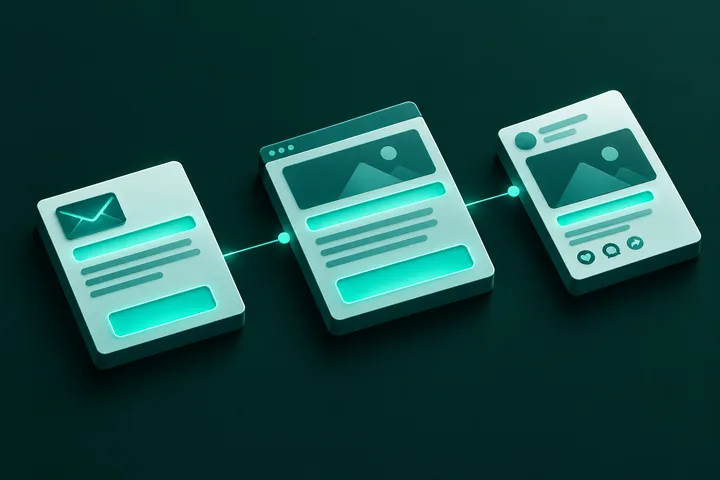
The AIDA model (Attention, Interest, Desire, Action) gives each part of a campaign one job. In a real campaign, attention is the hook that stops the scroll, interest is the useful detail that keeps people reading, desire is the proof and benefit that makes them want it, and action is one clear next step. The seven examples below show what that looks like in practice.
Key takeaways
- Each AIDA stage is a job for a specific part of the message, not a separate campaign.
- Attention is judged by the hook, interest by the detail, desire by the proof and action by how easy the next step is.
- The same model works in B2B, retail and services, but the proof and the call to action change with the buyer.
- In APAC, the channel and the language of the message often matter as much as the structure.
- If a stage is weak, fix that stage only: measure where people drop off before rewriting everything.
What does each AIDA stage look like in practice?
Each stage has one signal you can check in an ad, email or page. If you can point to the line that does the job, the stage is covered. If you cannot, it is missing.
| Stage | The job | What to look for | Typical measure |
|---|---|---|---|
| Attention | Stop the scroll | A specific hook, image or number | Thumb-stop rate, impressions, open rate |
| Interest | Earn the next ten seconds | A relevant detail the reader did not have | Watch time, scroll depth, clicks |
| Desire | Make them want it | Proof, a vivid benefit, a reason to choose you | Saves, replies, add-to-basket |
| Action | Remove the friction | One next step with a clear cost | Conversion rate |
For the model's basics, see our beginner's guide to the AIDA marketing model. This post is about examples.
What are some AIDA model examples?
All seven examples are hypothetical. They are written to show the structure, not to report results from a real brand.
1. B2B software: a LinkedIn ad (hypothetical)
- Attention: "Your sales team spends Monday morning copying numbers between three tools."
- Interest: "Here is the 90-second version of how a finance team removed that step."
- Desire: a short customer quote and one before-and-after figure the customer has agreed to share.
- Action: "Book a 20-minute walkthrough."
Note the call to action. A B2B buyer is not ready to pay. A small, low-risk step fits the stage.
2. Retail: a product launch email (hypothetical)
- Attention: subject line "The jacket that packs into its own pocket".
- Interest: three lines on the fabric, the weight and the pocket.
- Desire: a photo of the jacket in use and two short reviews.
- Action: one button, "Shop the jacket", with free returns stated beside it.
3. Local services: an Instagram reel (hypothetical)
- Attention: the first second shows a dull tile floor turning bright.
- Interest: the cleaner names the product and the method as they work.
- Desire: a finished-floor shot and a customer comment pinned to the post.
- Action: "Message us your postcode for a quote."
4. Subscription app: a landing page (hypothetical)
- Attention: a headline that states the result: "Learn 20 phrases before your trip."
- Interest: a three-step "how it works" strip.
- Desire: app-store ratings quoted accurately, with a link to the source.
- Action: "Start your free week", with the price after the trial shown plainly.
5. APAC example: a Singapore food brand on Instagram and WhatsApp (hypothetical)
A hypothetical frozen-dumpling brand in Singapore wants first orders before Lunar New Year.
- Attention: a reel of a family steaming a batch, with a caption in English and Chinese.
- Interest: a carousel on the three fillings and how many each box serves.
- Desire: a sample-box offer and a photo of a table laid for a reunion dinner.
- Action: a click-to-WhatsApp button so people can ask a question and order in one chat.
The structure is the same as in the retail example. What changes is the channel, the language and the festive moment. Our APAC marketing calendar and our post on why localisation in Asia is not translation go deeper.
6. Paid search: a text ad and landing page (hypothetical)
Search ads compress AIDA into a few lines. The headline carries attention and interest together: it repeats the searcher's words and names one benefit. The description adds desire with one proof point. The landing page opens with the same promise and puts one button above the fold.
7. Webinar sign-up: a three-email sequence (hypothetical)
- Email 1 (attention): one surprising finding from the topic.
- Email 2 (interest and desire): the agenda and a named speaker.
- Email 3 (action): a reminder with the time in the reader's own time zone.
Here the stages are spread across messages, not packed into one.
Why do AIDA examples fail?
Most failures come from skipping a stage or giving one stage two jobs. Four patterns repeat.
- Attention without interest. A clever hook that leads to a generic page. People click, then leave.
- Interest without desire. Lots of features, no proof and no reason to choose you over a rival.
- Desire without action. A lovely ad that ends with no button, or three buttons.
- Action too early. "Buy now" in the first line, to people who have just met you.
How do you check which stage is weak?
Match each stage to the number that shows its drop-off. A low thumb-stop rate points to attention. Good clicks but short visits point to interest. Visits with few saves or add-to-baskets point to desire. Basket starts with no purchase point to action.
Competitor ads are a useful reference. Reading what rivals use as hooks and proof shows which claims are crowded and which are free. Our guide to researching competitor ads in the Meta Ad Library shows how to collect them, and what marketing whitespace is explains how to spot the gaps.
Is AIDA still useful?
Yes, as a drafting and review checklist. It is not a literal description of how people buy: real journeys loop and skip. For a comparison with other models, see AIDA vs the marketing funnel vs AARRR vs See-Think-Do-Care. For fill-in wording, see our AIDA copy templates.
FAQ
What is an example of the AIDA model?
A launch email is a simple case. The subject line gets attention, three lines of detail build interest, a photo and reviews create desire, and one button asks for the action.
Does every ad need all four AIDA stages?
Not in one piece. A short ad may do attention and interest only, and leave desire and action to the landing page or a follow-up email. What matters is that the whole journey covers all four.
Can AIDA work for B2B?
Yes. The stages are the same, but the proof is usually a case study or a figure from a customer, and the action is a smaller step such as a demo or a call, not a purchase.
How is AIDA different for social media?
Attention has to land in the first second or the first line, because people scroll fast. Interest and desire often sit in the carousel, caption or comments, and action is a tap on a button or a message.
Are these examples from real campaigns?
No. Every example here is hypothetical and is written to show the structure. We do not report results for them.