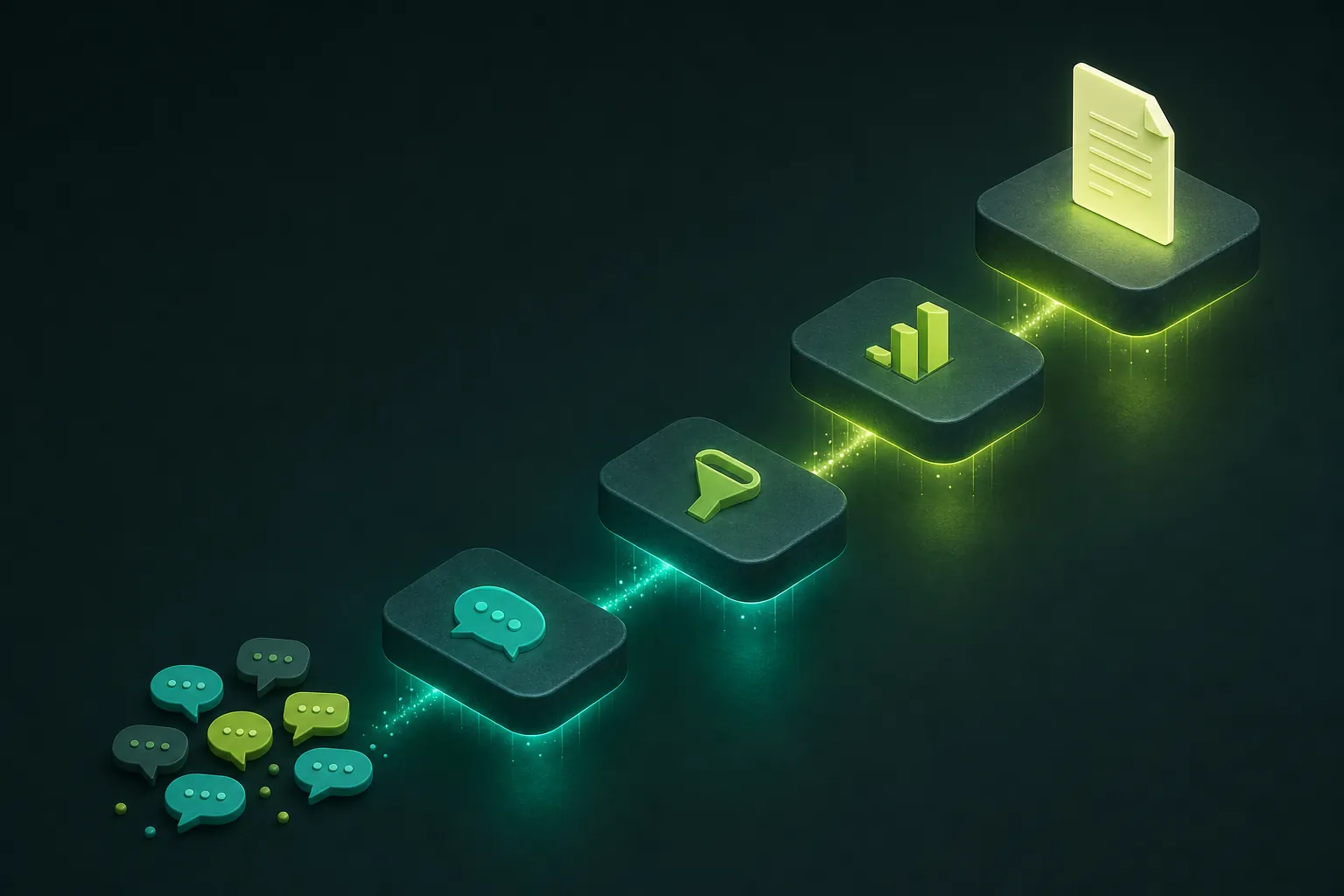
To turn a social listening insight into a campaign brief, carry it through two middle steps before you write anything: the moment, when and where the tension shows up for your audience, and the proposition, what your product promises at that moment and why anyone should believe it. Then fill the brief from those four parts and keep the evidence attached, so anyone reviewing it can trace each line back to real posts.
Key takeaways
- An insight explains why people behave as they do; a brief tells a team what to make. The moment and the proposition connect the two.
- Check an insight against its evidence before you use it: how many posts, from which brands, over what period.
- A moment turns a general tension into a trigger you can plan channels and timing around.
- A proposition pairs one promise with one proof. Generated taglines are raw material, not copy.
- Keep the IDs and the evidence trail in the brief, so reviewers can check the reasoning as well as the wording.
Why do social listening insights stall before they reach the brief?
Because an insight deck describes an audience, while a brief has to make decisions: one audience, one message, one proof, one measure of success. When nobody does that translation, agencies receive briefs they cannot act on.
The BetterBriefs project has measured the gap. In its global survey of 1,700 marketers and agency staff in 2021, 78% of marketers said their briefs gave clear direction, while only 5% of agencies agreed, as Marketing Week reported. Its 2022 UK survey of 508 people, released with the IPA, found that only 6% of UK agencies were clear on the strategic direction in client briefs and only 30% of marketers had clear criteria for judging the work.
Social listening can make the gap wider. An insight that arrives as a theme name, with no tension, trigger or proof attached, gives the brief writer nothing to decide with.
What counts as an insight, and what does not?
An insight is a human truth with a tension inside it: who the audience is, what they want, what gets in the way and why. "Marketers talk about AI a lot" is an observation. "Strategists want the speed of AI but do not trust conclusions they cannot check" is an insight, because it names a conflict a brand can resolve.
In SOMIN, an insight combines three parts: a persona, a pain point (the tension) and an angle, which is a theory that explains why the tension exists. Our guide to what a consumer tension is covers how to find and test the tension itself. Here we pick up once you have one.
Step 1: how do you choose and check the insight?
Pick one insight with a clear tension and enough evidence behind it, then read the posts it came from.
Our worked example comes from SOMIN's audience-research workspace, which tracks GWI, Nielsen, Euromonitor and Milieu alongside SOMIN. A Perspective Study of 229 pieces of content published in the workspace between 8 April and 6 July 2026 grouped 51 of them into a pain-point theme called "Navigating the Complexity of Consumer Insights in a Digitally-Driven Market": 31 from GWI, 9 from Nielsen, 7 from Milieu and 4 from Euromonitor. The theme's summary describes companies struggling to pull usable insight out of overwhelming data, and worrying that inaccurate AI could damage their relationships with customers.
From that theme and a persona called The Insightful Strategist, SOMIN generated an insight with the angle "Distrust in Automation", grounded in trust theory:
Trust is bred in the soil of conversation, not in the data of algorithms.
Before going further, run three checks:
- Evidence. 51 posts from four brands over three months is enough to work with, but GWI supplied 31 of them. The tension is real in the category's content, and it is mostly GWI's framing of it.
- Tension. Can you state it in one line? Here: strategists want the scale of automated insight, but they distrust conclusions produced by systems they cannot see into.
- Fit. Can your product resolve the tension credibly? If the honest answer is no, pick another insight. A brief built on a tension you cannot answer produces work that sounds right and convinces nobody.
Step 2: how do you find the moment the tension shows up?
A moment is the point at which the audience feels the tension and can act on it: a search, a purchase decision, a career change, a frustrating day. It answers "when and where", which a theme never does. SOMIN generates several types of moment; micro-moments follow the familiar I-want-to-know, I-want-to-do, I-want-to-buy and I-want-to-go pattern.
A later 30-day study in the same workspace (August 2026, 215 pieces of content) produced this micro-moment for a persona called The Tech-Driven Innovator, facing a pain point about measuring audiences across fragmented media:
- Moment: Finding Reliable Data on Consumer Behavior (I-want-to-know)
- Thought: "I want to find trustworthy data that reflects real consumer behavior."
The moment comes from a different study and persona than the insight, so we checked the fit rather than assuming it. Both personas are data-literate strategists. The insight's tension is distrust of conclusions from black-box systems; the moment is the active search for data that can be trusted. They describe the same conflict from two sides. If you have to argue at length that a moment fits an insight, it does not.
Check the moment's evidence too. That study also included LinkedIn posts by SOMIN team members, which supplied 18 of the 70 posts in the pain-point theme behind this moment. When a moment draws partly on your own content, give it less weight than one drawn only from the market.
Like the insight, the moment is generated by a model from published content. It is not a quote from a real person, so treat it as a hypothesis about timing and confirm it with search data, sales calls or your own customer conversations.
What the moment adds to the brief is concrete: a trigger (the audience is evaluating data sources), a state of mind (sceptical, comparing options) and, by implication, the places where that happens, such as search, peer recommendations and vendor comparison pages.
Step 3: how do you write the proposition?
A proposition joins the insight to one product truth: a feature, a reason to believe, a unique selling point or an offer. It should resolve the tension, not just sit next to it.
SOMIN generated two propositions for this insight, using the SOMIN product itself:
- Unique selling point: "Reverse-engineers strategy from real published content, not surveys — and every AI conclusion can be checked against the posts behind it."
- Reason to believe: "Concept tags trace to the specific posts that evidence them."
Each proposition comes with five generated routes. The one that best matches the moment is called "Conversations First, Data Second". Its consumer takeaway reads "I want insights that feel grounded in real conversations, not just numbers", and its sample tagline is "Start with People, End with Insights: SOMIN Redefines Data."
Treat that tagline as raw material. The useful parts are the consumer takeaway, which mirrors the moment's thought almost word for word, and the proof, which answers the distrust directly: you do not have to take the conclusion on trust, because you can open the posts behind it. A good proposition is one promise and one proof that the audience, at that moment, would accept.
Step 4: how do you write the brief?
Fill each field from the chain, and leave a field empty rather than invent it. The table shows a fill-in structure with the worked example; where we had to make an assumption for illustration, the field says so.
| Field | What to write | Worked example |
|---|---|---|
| Objective | The business result the work serves, in one line | Illustrative: more strategists who are comparing insight sources ask for a sample analysis. The target number comes from sales, not from the brief writer. |
| Audience | The persona, in plain words | Data-literate strategists who research audiences for a living (The Insightful Strategist; The Tech-Driven Innovator) |
| Tension | The insight's conflict, then the insight line | They want the scale of automated insight but distrust conclusions they cannot check. "Trust is bred in the soil of conversation, not in the data of algorithms." |
| Moment | Trigger, state of mind, place | Actively looking for "trustworthy data that reflects real consumer behavior"; sceptical and comparing sources |
| Single-minded proposition | One sentence the audience should take away | Every conclusion links to the published posts behind it, so you can check it before you use it. |
| Proof | Reason to believe, shown rather than claimed | Concept tags trace to the specific posts that evidence them; the creative shows a tag opening its posts. |
| Think, feel, do | The response you want | Think: I can verify this. Feel: in control. Do: open a sample analysis. |
| Channels and formats | Where the moment happens, and what fits it | Illustrative: search and LinkedIn, with a short screen-recorded demo of a conclusion being traced to its posts |
| Mandatories | Brand, legal and claims rules | Make only claims the product can show on screen. |
| Measurement | How the work will be judged, agreed before launch | Pre-score the creative, then judge the test on one primary metric chosen in advance. |
| Evidence trail | Sources and IDs a reviewer can open | Insight 1786, moment 13170, propositions 5095 and 5096; source study of 229 pieces of content, 8 April to 6 July 2026 |
A brief built this way is short because every field is a decision. For a blank version with the persona, tension, angle and story fields laid out, use our creative brief template.
How do you keep an AI-assisted brief honest?
Let the model propose and a person decide, and make every claim checkable.
- Read the posts behind the insight. Note who supplied them. Here, one brand produced most of the evidence, which shapes how far the insight generalises.
- Label generated material as generated. Personas, moments and taglines are model output. Say so in the brief, so nobody presents a generated thought as a customer quote.
- Filter out test and placeholder objects. Shared workspaces collect them. We skipped several test propositions in these workspaces before choosing the example above.
- Keep one human owner per decision. Which tension, which proof and what counts as success are choices someone has to be accountable for.
The trust question deserves its own treatment, and we give it one in why marketers distrust AI insights. If you want the whole chain run on your own category, from listening to a client-ready brief, SOMIN Strategy does it with every step linked to its evidence.
FAQ
What is the difference between an insight and a proposition?
An insight is a truth about the audience that contains a tension. A proposition is what your brand offers to resolve that tension, with a proof attached. One insight can support several propositions, for different products or different proofs.
What is a moment in marketing?
A moment is a specific point at which the audience feels a need and can act on it, such as a search, a purchase decision or a life change. It tells the brief when and where to reach people, which an insight on its own does not.
How long should a campaign brief be?
Short enough that every field is a decision rather than background. If a field needs a paragraph of explanation, the decision behind it has usually not been made yet. Put supporting research in an appendix and link to it.
Can AI write the campaign brief for me?
AI can draft most fields from data, including personas, tensions, moments and candidate propositions. The choices that matter, such as which tension to own, which proof to lead with and how success will be judged, still need a person who is accountable for them.
What if the insight and the moment come from different studies?
That is fine if they describe the same tension from two sides, as in our example. Check the fit explicitly: same kind of person, same conflict, a moment where acting on it is possible. If the connection needs a long argument, choose a different moment.
Sources
- IPA, New better briefing best practice guide to address industry shortcomings, 6 July 2022.
- Marketing Week, Best practice guide unveiled to tackle ineffective briefs, 6 July 2022.