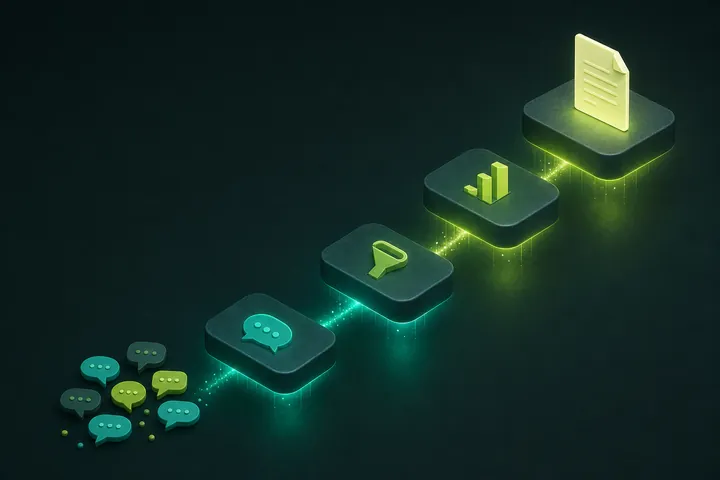
Marketers distrust AI insights because they cannot see where a conclusion came from, and because acting on a confident mistake is expensive. In a GWI survey of more than 450 marketers in the UK, the US and Singapore, published in September 2026, 72% said their organisation had made a significant decision on AI-generated insight that later proved wrong, yet only 37% verify AI insights most of the time. The fix is to make every AI conclusion traceable to its sample, its evidence and its reasoning, so a person can check it before anyone acts on it.
Key takeaways
- The distrust is partly earned: most marketing teams in GWI's survey have already acted on an AI insight that turned out to be wrong, and checking is still the exception.
- Over-trust is common too: in KPMG and the University of Melbourne's 47-country study, 66% of employees rely on AI output at work without evaluating it.
- Research on trust in automation points to calibrated reliance, and people accept imperfect algorithms when they can inspect and adjust them.
- An AI insight is verifiable when it states its sample, links each claim to the evidence behind it, names its mechanism and labels what the model inferred.
- We audit one of SOMIN's own AI insights below; the checks caught noise in the evidence and a shift in audience that would have misled a brief.
Why do marketers distrust AI insights?
Three reasons come up again and again: the insight arrives as a black box, its errors are delivered with the same confidence as its facts, and the cost of a wrong call lands on the marketer, not the tool.
The cost is no longer hypothetical. In GWI's survey, 37% of marketers said a wrong AI insight had led to financial losses, 35% to customer complaints and 32% to reputational damage, and 44% had redone work because of inaccurate outputs. GWI sells survey data for use in AI tools, so it has a stake in the answer, but the pattern matches wider research.
KPMG and the University of Melbourne surveyed 48,000 people across 47 countries for their 2025 global study of trust in AI. Just over half (54%) said they are wary of trusting AI, and 56% of employees said they had made mistakes at work because of it.
Psychology adds a twist. Across five studies, Berkeley Dietvorst, Joseph Simmons and Cade Massey found that people lose confidence in an algorithm faster than in a human after seeing both make the same mistake, even when the algorithm was more accurate overall. They called it algorithm aversion. One visible error in an AI insight can sink a whole tool in a team's eyes.
Is the distrust a problem or a sensible reaction?
Both, depending on what it leads to. The goal is not more trust but the right amount. John Lee and Katrina See's 2004 review in Human Factors framed the problem as appropriate reliance: automation goes wrong when people fail to rely on it appropriately, trusting it either more or less than its capabilities justify.
Marketing shows both failures at once. The KPMG study found 66% of employees rely on AI output at work without evaluating or validating it, while GWI's data shows most marketers do not routinely verify AI insights. Teams swing between taking a chart at face value and binning a tool after one bad call.
The same researchers also found a way out. In a 2018 follow-up in Management Science, people were much more willing to use an imperfect forecasting algorithm when they could modify its output, even slightly, and their forecasts improved. Trust rose with control. For an insight, control starts with seeing the evidence and being able to edit the conclusion.
What does SOMIN's own data say about distrust in automation?
SOMIN's insight engine surfaced the same theme from the audience-research category. In a July 2026 study of 229 paid items from GWI, Nielsen, Milieu and Euromonitor, dated 8 April to 6 July 2026, it grouped 51 into a tension titled "Navigating the Complexity of Consumer Insights in a Digitally-Driven Market": companies struggle to pull actionable insight from overwhelming data, lean on broad generational labels, and worry that AI inaccuracies damage their understanding of the market. From that tension it built this chain:
- Persona: the Insightful Strategist, a market-analysis and business-strategy professional who prioritises knowledge and data-driven decisions, built from 63 items in the same study, 46 of them GWI ads.
- Angle: Distrust in Automation, which SOMIN's model filed under trust theory: trust is built through consistency and transparency, and AI used without clear communication erodes it. In the research literature this is the field of trust in automation that Lee and See reviewed.
- Insight: "Trust is bred in the soil of conversation, not in the data of algorithms."
The category's own marketing sells against the same fear. GWI's ads for Agent Spark, which brings GWI survey data into AI assistants, promise verified insights from real consumers instead of web-scraped content. On GWI's organic channels, the 23 posts tagged with an AI topic averaged 83 engagements, almost three times GWI's overall average of 29, between 18 October 2025 and 17 October 2026. Our study of how audience research firms market their data has the wider picture.
When SOMIN paired the insight with its own product, the propositions rested on a property rather than a feature: every AI conclusion can be checked against the posts behind it, and concept tags trace to the specific posts that evidence them. That is the standard the rest of this article applies, including to SOMIN.
What makes an AI insight verifiable?
An AI insight is verifiable when a sceptical colleague can trace it from the conclusion back to the evidence in a few minutes. The NIST AI Risk Management Framework gives useful words for the parts: transparency answers what happened, explainability answers how a result was reached and interpretability answers why. NIST lists accountability and transparency, and explainability and interpretability, among the characteristics of trustworthy AI.
For a marketing insight, that means four visible layers:
- The sample: sources, brands, platforms, date range and size.
- The evidence: links to the actual posts, ads or rows behind each claim, with counts.
- The reasoning: the mechanism, named, with a source for the theory.
- The status: a plain label separating what was observed from what the model inferred.
In SOMIN Strategy, each persona and tension opens onto the content library filtered to the posts or ads behind it. That link is what made the audit below possible.
How do you audit an AI insight in practice?
We ran the "Trust is bred in the soil of conversation" insight through those layers in October 2026.
| Check | What we found | Verdict |
|---|---|---|
| Sample stated | 229 paid items from the ad libraries of GWI, Nielsen, Milieu and Euromonitor, 8 April to 6 July 2026 | Pass |
| Evidence linked | The tension opens onto the 51 items behind it in the content library | Pass |
| Evidence on topic | Some items were Nielsen ads recruiting members for its Computer & Mobile Panel, which say nothing about trust in insight | Some noise: drop off-topic items before briefing |
| Concentration | 31 of the 51 items came from GWI | One advertiser's message dominates |
| Angle matches evidence | The angle describes consumers distrusting brands that use AI; the evidence is research firms selling to marketers | Audience shift: rewrite the angle for a business buyer |
| Theory checked | "Trust theory" is a broad label; the established research is on trust in automation and algorithm aversion | Re-cite to the primary research |
The verdict: the insight is a fair reading of how the audience-research category sells, built mostly on one company's ads, and a hypothesis about buyers rather than a measured attitude. It is usable once the angle is rewritten for marketers and the off-topic items are removed. Without the audit, it could easily have gone into a brief as a finding about consumers. For how tensions and angles fit together, see what is a consumer tension.
What should an AI insight checklist include?
Ten checks cover most of it. Run the first five on every insight and all ten before a decision that moves budget.
- State the sample in one line: sources, brands, platforms, dates and the number of items.
- Link every number to its evidence, and show the denominator: 51 of 229 says more than "a major theme".
- Open a random sample of the evidence, ten to twenty items, and count the ones that are off topic.
- Check concentration. If one brand or account supplies most of the evidence, say so.
- Label what is model-generated. Personas, tensions and insights produced by AI are hypotheses until checked.
- Check the theory against a primary source. Drop names you cannot find in the research literature.
- Check the audience. Does the evidence come from the same people the conclusion talks about?
- Save the evidence when the analysis runs: post IDs, links and screenshots, because posts get deleted and ads stop running.
- Cross-check big calls against an independent source, such as a survey, sales data or a small test.
- Let the owner edit the conclusion, and log who changed it, who signed it off and when.
These are the insight-level twin of the copy checks in our guide to AI hallucinations in marketing. Explainable AI for marketing is also a research question for us: Prof. Aleks Farseev and the SOMIN team have published on it at ACM Multimedia and The Web Conference, and the papers are listed on the SOMIN research page.
FAQ
Why don't marketers trust AI-generated insights?
Mostly because they cannot see the evidence behind a conclusion and have been burned by confident errors. In GWI's 2026 survey, 72% of marketers said their organisation had made a significant decision on an AI insight that later proved wrong.
What is algorithm aversion?
It is the tendency to lose faith in an algorithm faster than in a human after seeing it make a mistake, described by Dietvorst, Simmons and Massey in 2015. Their later work found that letting people adjust an algorithm's output reduces the effect.
How do I check whether an AI insight is accurate?
Ask for the sample, open a random selection of the posts or rows behind it, count the off-topic ones and check whether the evidence comes from the audience the insight describes. Then confirm big decisions against an independent source.
What is the difference between explainable and verifiable AI?
Explainable AI tells you how a result was reached. A verifiable insight goes further: it lets you inspect the evidence yourself and reach your own view, so you are not relying on the explanation alone.
Should marketers stop using AI for audience insights?
No. AI is good at clustering large volumes of content and proposing tensions quickly. Treat its output as a hypothesis with a paper trail, and keep a person responsible for checking and signing it off.
Sources
- GWI: Marketers say wrong AI insight has already cost their organization (September 2026)
- KPMG and the University of Melbourne: Trust, attitudes and use of artificial intelligence, a global study 2025 (executive summary)
- Dietvorst, Simmons and Massey (2015), Algorithm aversion: people erroneously avoid algorithms after seeing them err, Journal of Experimental Psychology: General 144(1)
- Dietvorst, Simmons and Massey (2018), Overcoming algorithm aversion, Management Science 64(3)
- Lee and See (2004), Trust in automation: designing for appropriate reliance, Human Factors 46(1)
- NIST AI Resource Center: AI risks and trustworthiness