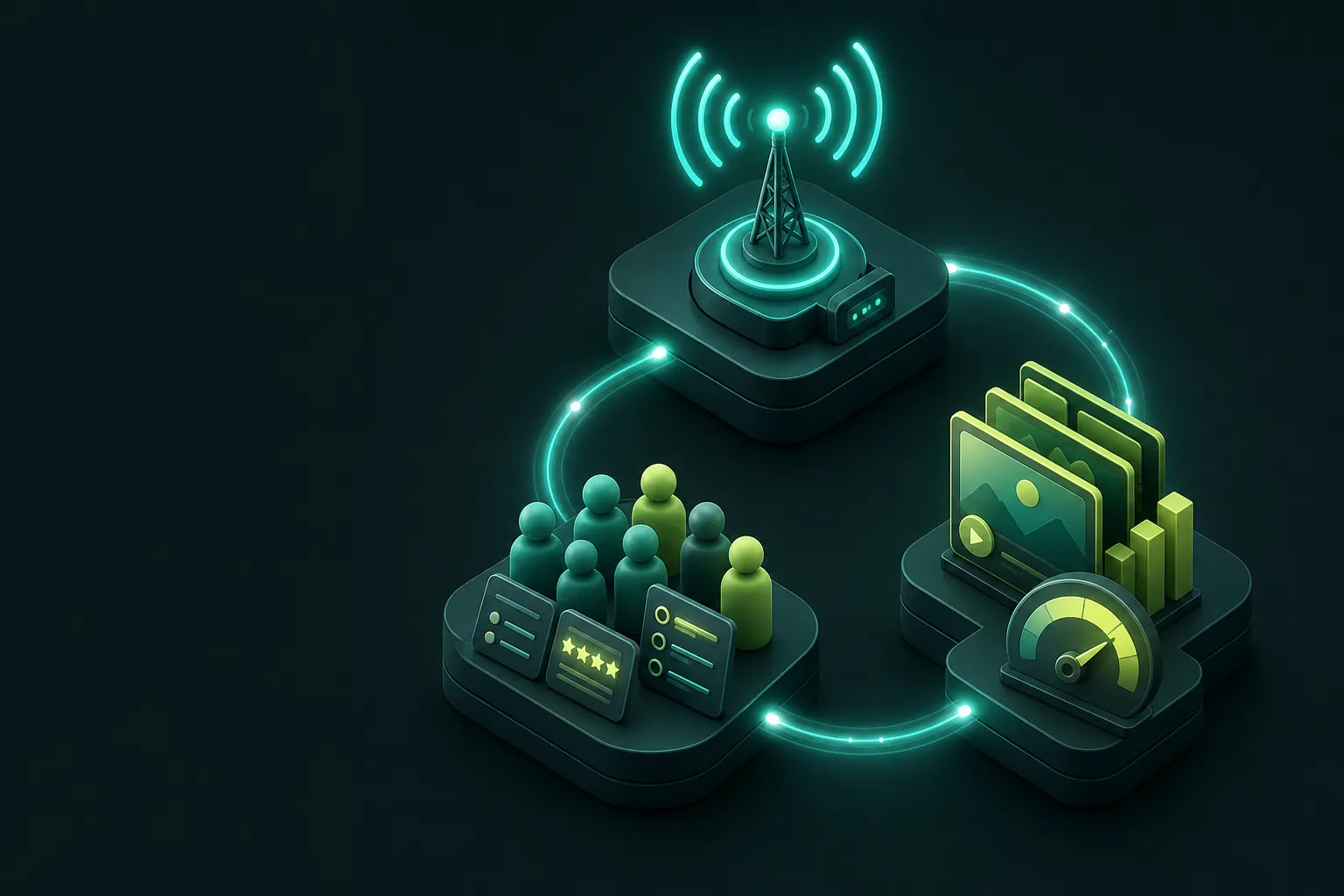
Social listening tells you what people are saying about a brand or category right now. Audience research tells you who your audience is, how big it is and what it believes. Ad optimisation decides which ads to run, to whom and with how much budget. Most marketing teams end up using all three, but the right one to start with is the one that answers the decision in front of you: what to say, who to say it to, or where to spend.
Key takeaways
- Social listening answers "what is being said?" from public posts, news, forums and reviews. It is fast and unprompted, but it only hears people who post.
- Audience research answers "who is the audience and what do they think?" from surveys, panels and measurement. It is representative and comparable over time, but periodic.
- Ad optimisation answers "which ad, which audience, what budget?" from your own campaign data. It is closest to revenue, but it mostly improves what you already run.
- The three work as a loop: research defines the audience, listening shows what is live, a strategy step picks the angle, optimisation turns it into spend, and results feed back.
- Each category also markets itself differently. In SOMIN's data, audience research firms lead with findings, ad platforms with product and events, and listening vendors sit in between.
What does social listening do?
It collects and analyses public conversation about your brand, your competitors and your category, so you can see what is being said, how it is changing and where it is coming from.
Depending on the tool, the data comes from social posts and comments, news sites, blogs, forums and review sites. Typical outputs are mention volumes, sentiment, share of voice, trending topics, lists of influential accounts, crisis alerts and competitor benchmarks. Communications and PR teams, social media teams, brand managers and insight teams are the main users.
Its strength is that the conversation is live and unprompted: nobody was asked a question, so you hear what people choose to talk about. Its limits follow from the same fact. It hears only people who post publicly, it measures volume rather than importance, and it describes the conversation without telling you what to do next.
The market splits into two groups. Media and listening specialists include Meltwater, Talkwalker, Brand24, YouScan, Synthesio, Digimind and Awario. Social media management suites with listening or analytics built in include Sprout Social, Hootsuite, Sprinklr, Emplifi and Agorapulse. We analysed what 18 of these vendors publish themselves in what social listening tools post about.
What does audience research do?
It tells you who your audience is, how many of them there are and what they think, buy and watch, usually across several markets and in a form you can compare over time.
The data comes from surveys, research panels, audience measurement and market statistics. GWI, for example, describes its core dataset as a survey that has run quarterly since 2013, with data covering 53 markets and the same questions asked in each respondent's own language, according to its help centre. Typical outputs are audience profiles, segment sizes, attitudes, media habits, purchase behaviour and category forecasts. Strategy and planning teams, insight teams, media planners and product teams are the main users.
Its strength is reach beyond the people who post: a survey can ask about subjects nobody discusses in public and size the answer. Its limits are timing and distance from the creative. Data arrives in waves, answers are self-reported, and it does not show you what competitors are saying in their ads this week.
Examples include GWI, Nielsen, Euromonitor and Milieu, which SOMIN tracks in its audience research workspace. How these firms promote their own data is the subject of how audience research firms market their data.
What does ad optimisation do?
It decides which ads to run, to whom, at what bid and with what budget, then adjusts as results come in.
The data is mostly your own: campaign results from the ad platforms, your creative assets and your conversion signals. Typical outputs are creative variations, automated rules, budget and bid changes, A/B tests, reports and, in some tools, a predicted score for an ad before it runs. Performance marketers, media buyers, paid social teams and agencies are the main users.
Its strength is the direct line to spend and results. Its limit is that it optimises inside the brief it is given. Most tools learn after money is spent and tend to converge on what already works, so they rarely tell you about an angle you have not tried or an audience you are missing. The ad platforms now automate much of this themselves: Meta describes its Advantage+ shopping campaigns as tools to "automate audience, creative, budget, optimization, and destination" in a 2024 developer post.
Examples include Smartly, Madgicx, AdEspresso, Adzooma, Strike Social and Connectio, which SOMIN tracks in its ad optimisation workspace. What they promise in their own ads is covered in what ad optimisation platforms advertise.
How do the three categories compare?
They answer different questions from different data, so they rarely replace one another. The table sets them side by side.
| Social listening | Audience research | Ad optimisation | |
|---|---|---|---|
| Question it answers | What is being said about us, competitors and the category? | Who is our audience, how big is it and what does it think? | Which ads should run, for whom, with what budget? |
| Main data | Public posts, comments, news, forums, reviews | Surveys, panels, audience measurement, market data | Your campaign results, creative and conversion signals |
| Typical outputs | Mentions, sentiment, share of voice, trends, alerts | Profiles, segment sizes, attitudes, media habits | Variants, rules, bid and budget changes, tests, scores |
| Time frame | Real time to weekly | Quarterly or annual waves | Daily, during campaigns |
| Main users | PR, social, brand and insight teams | Strategy, planning, insight and media teams | Performance marketers, media buyers, agencies |
| Blind spot | People who do not post; what to do next | What competitors are saying this week | Angles and audiences you have not tried |
| Example vendors | Meltwater, Talkwalker, Brand24, Sprout Social, Sprinklr | GWI, Nielsen, Euromonitor, Milieu | Smartly, Madgicx, AdEspresso, Adzooma |
How do these categories market themselves?
Differently, and the difference is a useful clue to what each one sells. SOMIN tracks each category in its own workspace. Here is what the vendors published organically in the 90 days to 18 October 2026, with SOMIN's own posts left out:
- Social listening and management (18 vendors, 1,339 posts): 45% educational, 28% product offering, 4% topical and 4% event promotion.
- Audience research (4 firms, 356 posts): 58% educational, 21% topical and 20% product offering. Milieu (145 posts) and Nielsen (128) published most.
- Ad optimisation (6 vendors, 346 posts): 42% product offering, 39% educational and 20% event promotion. Smartly published 269 of the 346.
Audience research firms sell findings, so their free content is a sample of their data about the world. Ad platforms sell the product and the room where buyers meet it, so they lead with features and events. Listening vendors sit in between, with a heavy share of how-to content. When you evaluate a vendor, read its feed as a preview of what it values, then test the product on your own question.
How do social listening, audience research and ad optimisation fit together?
As a loop, with one step in the middle that none of the three does on its own: deciding what to say.
- Audience research defines who you are for and how big each segment is.
- Social listening shows what that audience and your competitors are saying now, including the tensions and shifts a survey would miss.
- Strategy picks the angle: the gap between what the audience cares about and what competitors already say. In most teams this is a person with a spreadsheet and a deadline.
- Ad optimisation turns the angle into variants, tests them and moves budget to what works.
- Results feed back into the next round of research and listening.
SOMIN works on steps 3 and 4. SOMIN Strategy reads the creative and conversation that is live in your category, finds the territory nobody owns and writes the brief. SOMIN Paid Media builds an on-brand funnel around what is winning in the category and scores each ad for likely click-through before you spend. It is a complement to listening and survey data, not a replacement for them.
The loop also changes what you publish yourself. Our study of what gets B2B martech content engagement on LinkedIn shows how category data can turn into simple, testable rules for your own channels.
Which one do you need first?
Start with the question that would cost you most to get wrong.
- Entering a new market or segment, or unsure who buys? Start with audience research.
- Managing reputation, a launch or a crisis, or watching competitors closely? Start with social listening.
- Already spending meaningfully on paid media and need better returns? Start with ad optimisation.
- Have plenty of data but cannot turn it into what to say? The gap is the strategy step, not another data source.
Whichever you choose, ask every vendor the same five questions. Where does the data come from? How fresh is it? Can I see the posts, respondents or ads behind a number? Does it cover my markets and languages? Which decision will this change, and how will I know?
FAQ
What is the difference between social listening and audience research?
Social listening analyses what people say in public, as it happens. Audience research asks a defined sample of people questions, or measures what they do, to describe who the audience is and how big each segment is. Listening is faster and unprompted; research is more representative.
Is social listening the same as social monitoring?
Not quite. Monitoring tracks individual mentions so you can respond, while listening looks for patterns across many conversations over time, such as shifts in sentiment or new topics. Most listening tools do both.
Can ad optimisation tools replace audience research?
No. Ad optimisation learns from the people your ads already reach, so it improves delivery to known audiences. It cannot tell you about people you are not reaching, or why they think the way they do.
Do I need all three?
Large teams usually use all three, often from different vendors. Smaller teams can start with the one that matches their biggest decision and add the others as spend grows.
Where does SOMIN fit among these tools?
SOMIN sits between them. It reads what is winning in your category's live creative and conversation, decides the angle and writes the brief, then scores ads before you spend. It works alongside listening and survey tools rather than replacing them.